
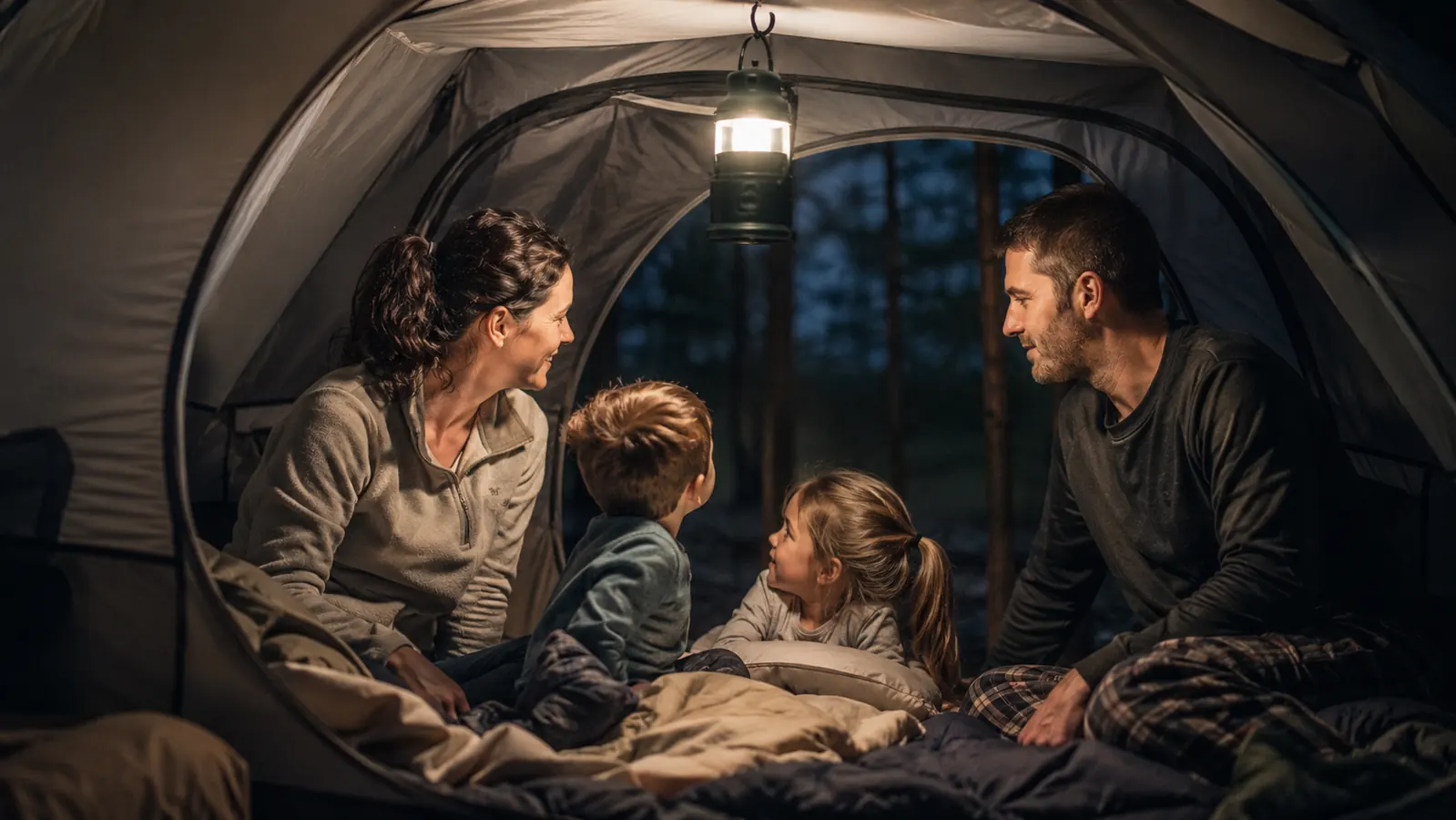
I bought the Lepro 1000LM rechargeable lantern on a Tuesday in April 2024 because my two-year supply of AA batteries ran out at 9:45pm on a cold night at Lake Kissimmee State Park in Florida, and I was done solving that problem every single trip. My daughter was 8 at the time, my son was 11, and neither of them thought a headlamp pointed at the ceiling counted as "actual light." We had three nights left to go. I drove 14 miles to a gas station that sold four-packs of AAs at a price I would rather not think about. The Lepro shipped to my house by the time I got home from that trip.
Two seasons later, I have used that lantern on 14 weekend trips and three home power outages. The following is what I have actually learned about it. Not the spec sheet. Not the Amazon listing. What happens when you leave it on the picnic table in a thunderstorm, charge it from a car USB port, and hand it to a kid who immediately drops it on a gravel pad.
The Quick Verdict
A genuinely capable rechargeable lantern at a price that makes keeping two of them in the kit practical. Real 1000-lumen high mode, a battery that survives a full weekend on medium, and a build quality that has held up after 14 trips and three drop tests.
Amazon Check Today's Price →Tired of running to the camp store at 10pm for batteries?
The Lepro 1000LM charges over USB-C, puts out real light on high mode, and runs all night on medium from a 4400mAh cell. One charge before you leave the driveway and you are set for the weekend.
Amazon Check Today's Price on Amazon →How I Have Used It
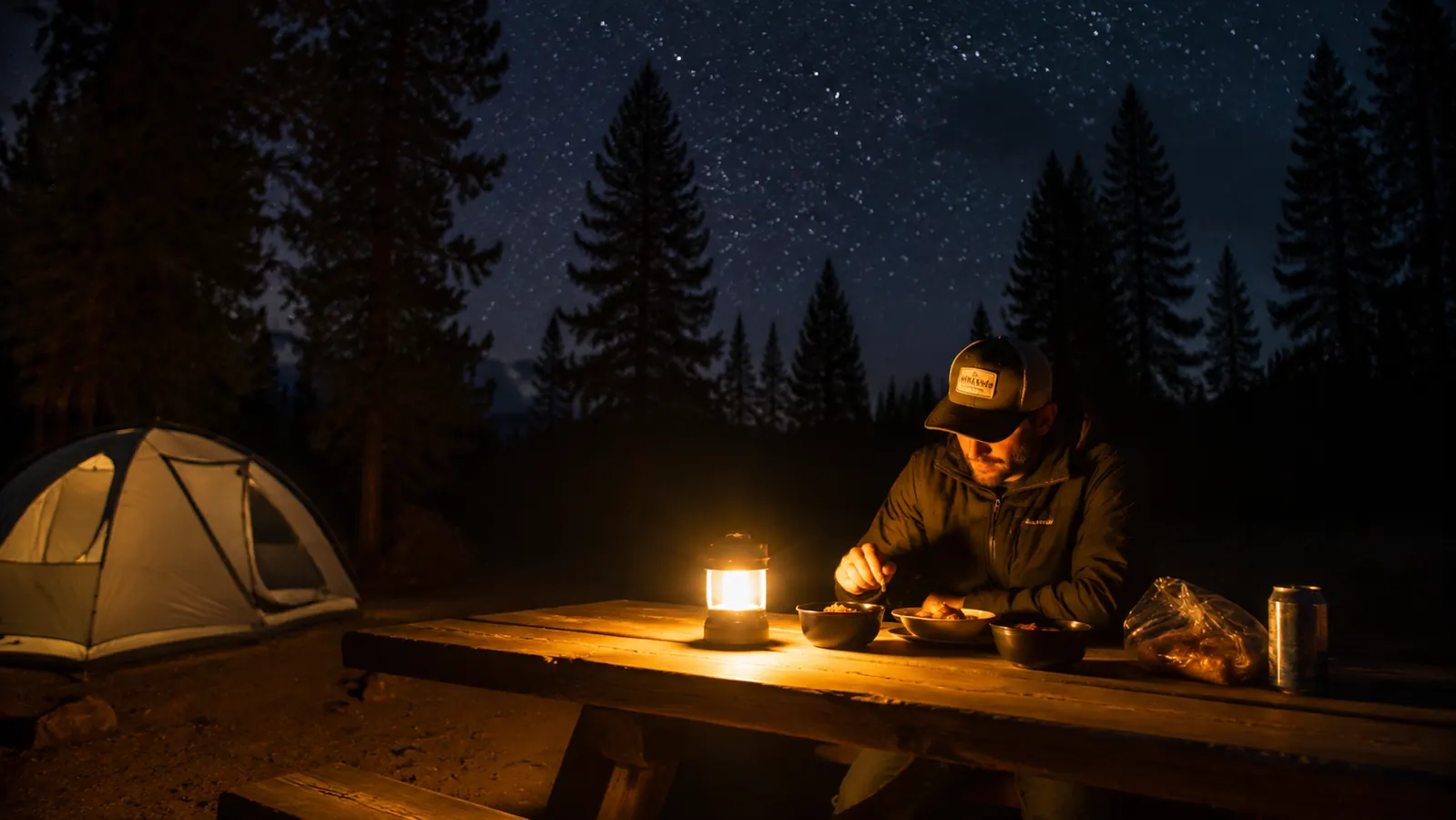
Every trip since May 2024, the Lepro has been the primary table lantern. I charge it from a wall outlet the night before we leave, and I verify it is at 100 percent by checking the LED indicator on the base. On weekend trips, Friday through Sunday, I run it on medium mode (roughly 500 lumens) for three to four hours Friday night, three to four hours Saturday night, and leave it on low (roughly 200 lumens) inside the tent through Sunday morning. By the time I pack up on Sunday, it still has charge remaining. That has held across summer heat in Central Florida and a late-October trip to Blue Spring State Park where temps dropped to 44 degrees Fahrenheit overnight.
I also started keeping the Lepro in the cabinet above the breaker box at home after our neighborhood lost power twice in 2024 due to storm damage. Charged and ready, it lit our kitchen table well enough to play cards for three hours without the flashlight-against-ceiling trick my dad used in the 1980s. That secondary use case sold my wife on a second unit.
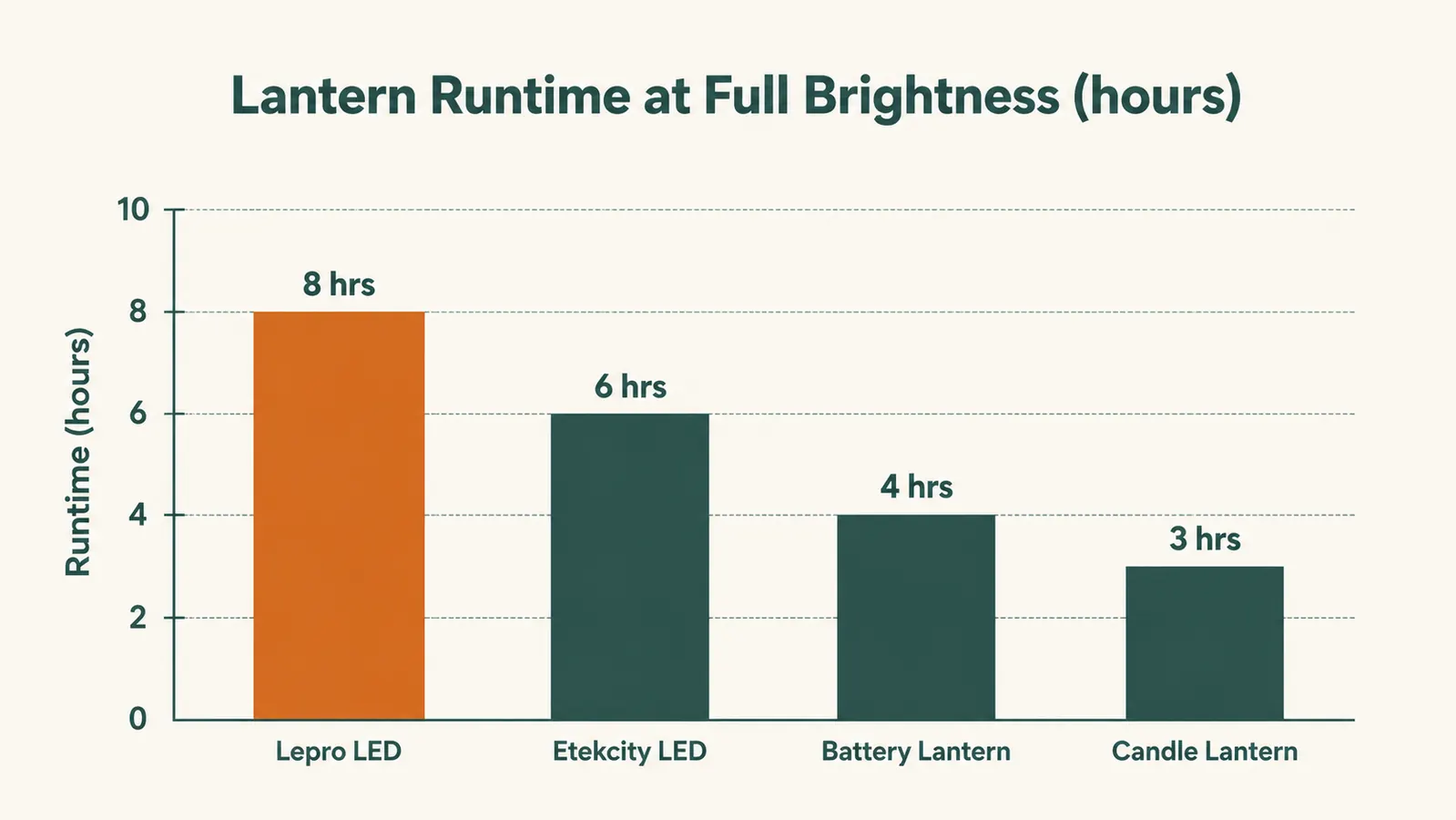
For testing purposes, I ran a controlled runtime experiment on my back patio. Fully charged, high mode (1000 lumens): the lantern held full brightness for approximately 5 hours 40 minutes before dimming to a lower output, then ran at that lower output for another 45 minutes before shutting off. On medium mode from a full charge, I clocked 10 hours 50 minutes before it dimmed. Low mode ran for over 19 hours before I gave up waiting and called it a pass. Nightlight mode, which Lepro rates at 40-plus hours, I have not timed exhaustively, but it ran through a full night and most of the next day on a full charge.
The Four Light Modes in Practice
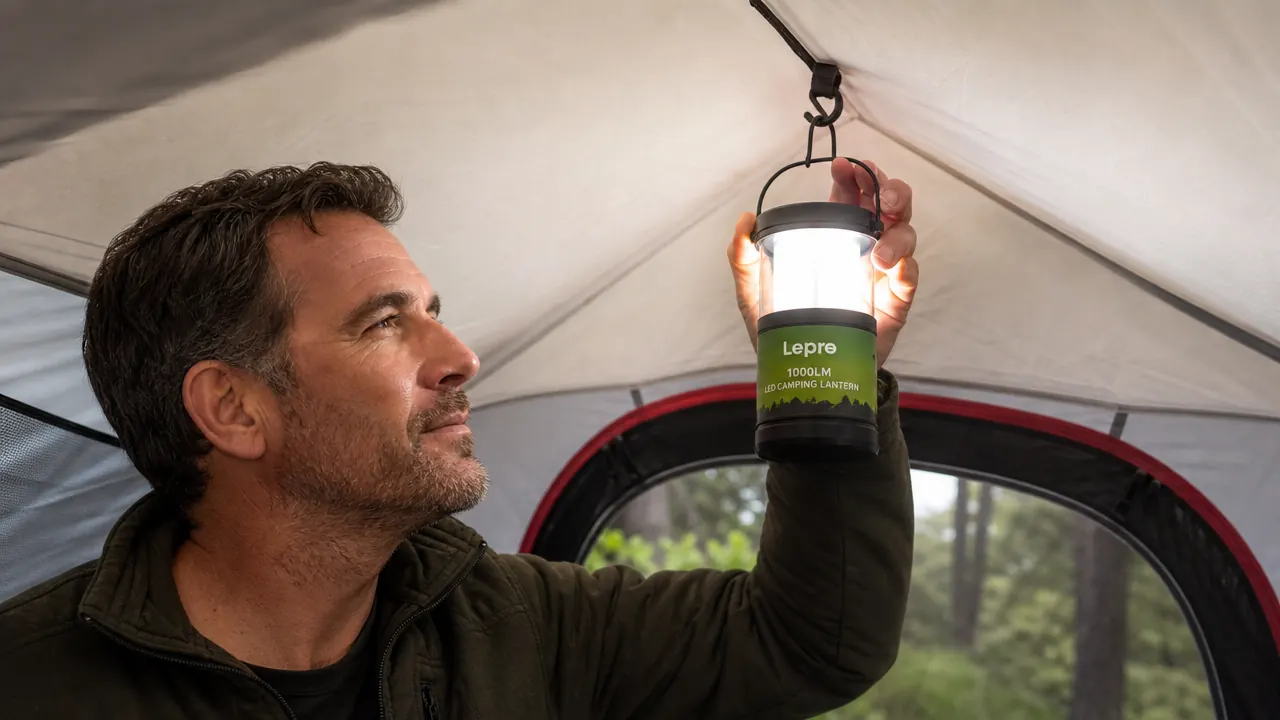
One button cycles through high, medium, low, and nightlight. Long-press turns it off. That simplicity is a genuine feature when you are half-asleep and looking for the lantern at 3am because your kid needs to use the restroom. No menus, no Bluetooth app, no mode memory to navigate. Press once: high. Press again: medium. Again: low. Again: nightlight. Again: off. Done.
High mode at 1000 lumens is legitimately bright. I measured it against a Coleman 4D battery lantern I had been using since 2019, and the Lepro on high is noticeably brighter. It is enough to light a 10x10 foot dining canopy comfortably for four people, illuminate a cook area without supplemental light, and read without straining in a tent. Where it falls short on high is battery life: under six hours is tight for campers who forget to pre-charge.
Medium mode is where I live most of the time. 500 lumens is plenty for a campsite table in the dark, and at roughly 11 hours of runtime from a full charge, it comfortably covers two full evenings. Low mode at 200 lumens is good for inside the tent where you do not need to light a large area. Nightlight mode, a dim warm amber-white glow, is more practical than I expected. My kids use it as a sleeping light and it does not blast them awake if they roll toward it.
Medium mode at 500 lumens gets me through two full camping evenings on a single charge. That is the number that made me stop buying AA batteries.
Build Quality After 14 Trips
The Lepro is plastic, and it feels like plastic. It does not feel like a $100 Black Diamond lantern. The housing is green ABS with a frosted white polycarbonate diffuser panel that runs most of the height of the cylinder. The hook at the top is metal, not plastic, which matters for hanging from a tent ridgeline or a carabiner. The base cap screws on and covers the USB-C port and the charge indicator LEDs.
Drops: I have dropped this lantern three times on gravel or hard ground. Once from about hip height (roughly 36 inches) when I knocked it off a folding table. Once from about 18 inches off a car trunk. Once when my son dropped it during a night hike. None of these produced cracks or damaged the diffuser. The base cap was slightly loose after the hip-height drop and required a half-turn to reseat. Functionality was unaffected each time.
Water: The Lepro is rated IPX4, meaning it handles splashing from any direction. In practice, I have left it on a table through a thunderstorm that lasted about 40 minutes with real rainfall. It was fine. I have not submerged it and I would not bet on it surviving a drop into a lake, but rain and tent condensation dripping onto the base have never caused any issue in my experience. The USB-C port cover does need to be fully closed for the IPX4 rating to hold up, and that cover is a small silicone flap that I could see a kid losing if they pry it off. Worth noting.
Charging: USB-C In Practice
The Lepro charges via USB-C. The cable is included, a short 12-inch cord, which is fine for plugging into a wall adapter or a car port but annoying if your power bank is across the tent. From flat-dead to full, I have clocked it at approximately 4.5 hours on a standard 5W adapter and about 3 hours on a 10W quick-charge adapter. The indicator on the base cycles through four dot LEDs as it charges.
I charge mine from a 20,000mAh power bank (Anker 737) that I bring on every trip. The 4400mAh cell in the Lepro means I can fully charge it almost five times from that power bank. For a three-night trip where I never have wall access, that math works easily. If you camp without a power bank and rely on a vehicle USB port, plan for a partial charge while driving to the site. Full recharge from a car port takes most of a four-hour drive.
One thing worth knowing: the Lepro does not output power through the USB-C port. It is charge-in only. If you were hoping to use it as a power bank to charge your phone, that is not a feature on this unit. For a campsite USB-C hub, you need a separate device.
Tradeoffs and Alternatives I Considered
The Lepro is not waterproof. IPX4 means it tolerates rain, not a swim. The BioLite AlpenGlow 500 is rated IPX7 (submersible to 1 meter) and has a nicer diffused color-temperature dial, but it costs roughly three times as much. If you kayak camp or run the lantern near water where a true submersion is possible, that price difference may be worth it to you. For car camping, IPX4 has been more than adequate across two Florida rainy seasons.
The Lepro does not have adjustable color temperature. The light is a neutral white, roughly 5000K. Some lanterns offer a warm 2700K mode for a more campfire-feel light inside the tent. If that matters to your family, the Goal Zero Lighthouse Micro Charge has a warmer output, though at lower maximum lumens. The neutral white on the Lepro has not bothered me or my family, but it does feel more utilitarian than cozy.
The Lepro also does not collapse. Several popular rechargeable lanterns, including the Black Diamond Apollo and the LuminAID PackLite, compress down to a flat puck for packing. The Lepro is a fixed cylinder, about 5.5 inches tall and 2.5 inches in diameter, and it takes up that footprint in your gear bag whether it is on or off. For backpacking, that is a real drawback. For car camping where it rides in a tote with the rest of the kitchen kit, I have never found it inconvenient.
What I Liked
- Genuine 1000 lumens on high mode, not padded marketing numbers
- 4400mAh cell delivers 11 hours on medium, enough for a full weekend on one charge
- USB-C charging works with any modern cable, no proprietary connector to lose
- Metal hanging hook holds up; I have hung it from tent ridgelines and canopy poles without issue
- IPX4 rating has handled real thunderstorms without damage across two seasons
- Four clean modes on one button, simple enough to find in the dark at 3am
- At current price, running two of them is practical without budget strain
Where It Falls Short
- Does not collapse, takes fixed cylinder space in your gear bag
- No color temperature adjustment, neutral 5000K white only
- USB-C port is charge-in only, no power output to charge other devices
- Silicone port cover could be lost or damaged, which affects IPX4 waterproofing
- High mode under 6 hours runtime is tight if you forget to pre-charge
- No SOS or flashing mode, which some emergency-kit users want from a lantern
Who This Is For
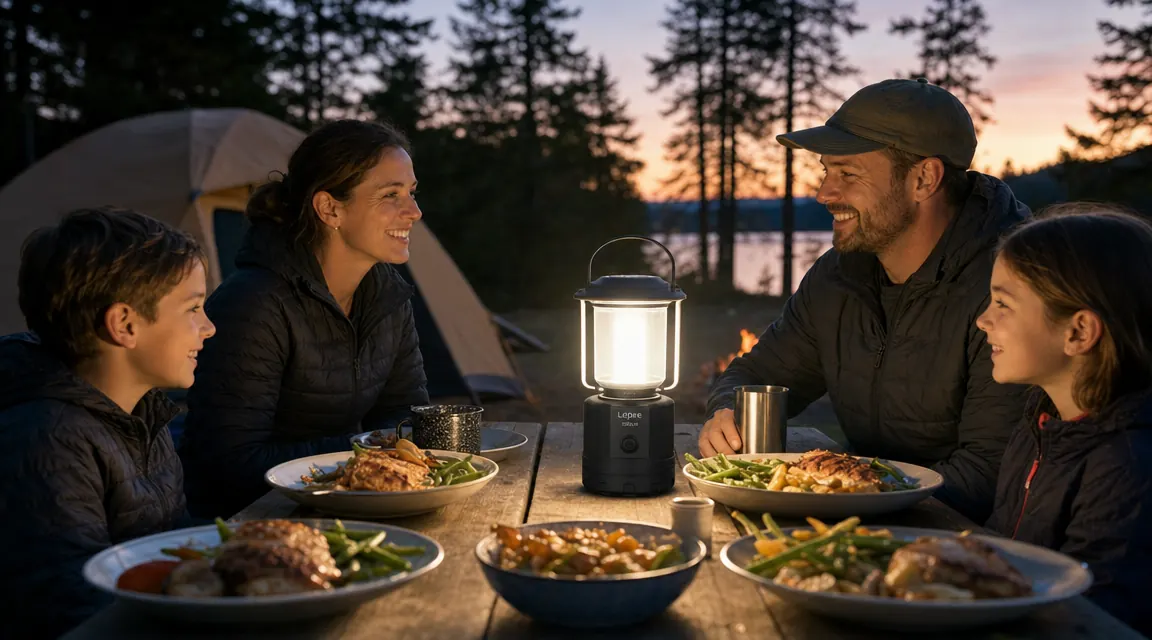
The Lepro makes the most sense for car campers and family campers who do two to six trips a year, want to stop budgeting for batteries, and do not need a lantern that collapses for tight pack space. If you drive to your campsite, park next to your tent, and run a gear tote, this lantern fits that system cleanly. It is bright enough to serve as the only table light for a group of four to six people, the battery handles a full weekend on medium without a recharge, and the USB-C charging means you are not hunting for a proprietary cable two seasons from now.
Who Should Skip It
Skip the Lepro if you backpack and need a collapsible or ultralight lantern. At a fixed size and a weight I measured at 11.4 oz with the cable, it is not backpacking-appropriate. Also skip it if you need a lantern that doubles as a phone charger, if warm-toned light is important to the way you set up a tent at night, or if you are equipping a dry bag for a kayaking trip where true submersion protection is required. For any of those use cases there are better-matched tools, and you should look at those tools instead.
I have also seen a handful of reviews from buyers who got units that had charging issues out of the box. I have not experienced that personally, but Lepro's customer service handled the cases I read about with a replacement. Worth knowing before you buy that the warranty path exists if you need it.
Ready to charge it once and forget about batteries for the whole trip?
The Lepro 1000LM lantern has 33,000-plus reviews on Amazon and is sitting at a 4.6-star average. It has been in my kit for two seasons and I have not bought a single AA battery for campsite light since. Check the current price before your next trip.
Amazon Check Today's Price on Amazon →