
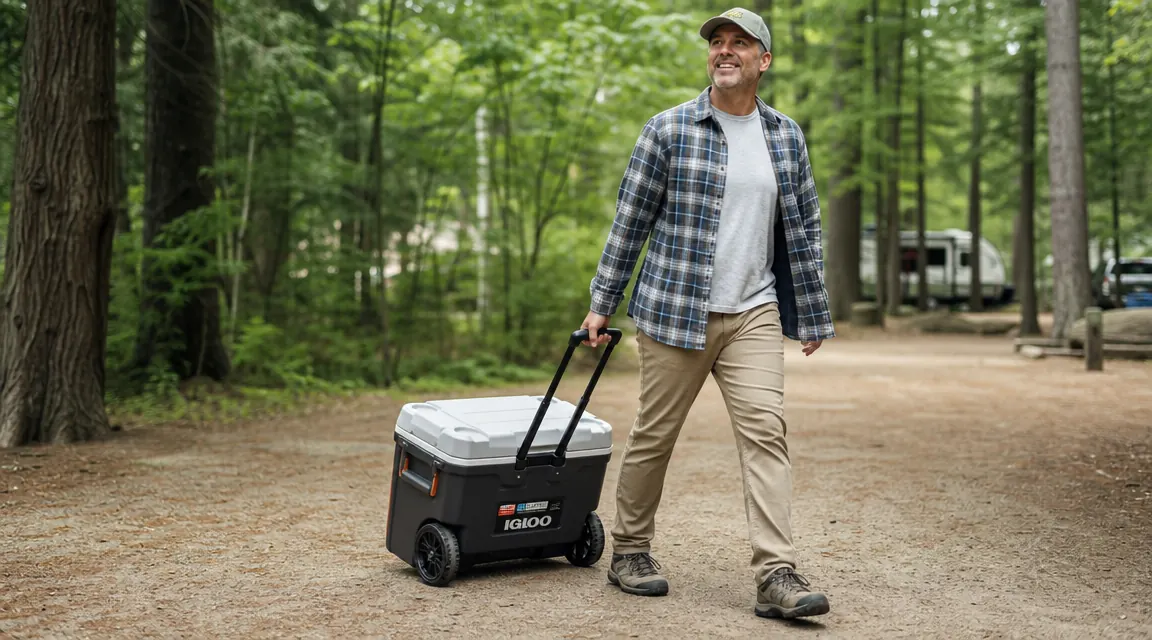
My back gave me the review before the cooler did. I used to run a 60-quart hard-sided chest cooler to every car camping trip, two-person carry, minimum, every time. Then my neighbor at campsite 14 at Raystown Lake rolled a Coleman Classic past me on the gravel, solo, without even looking at the ground. I watched him park it next to his table, flip the lid, and pull out a cold beer. I went home and ordered one. That was three summers ago, and I have since taken this cooler to 22 camping trips, four tailgates, and a six-day road loop through the Smoky Mountains with my daughter. Here is everything I know about it now that I did not know then.
The Coleman Classic Series 62-quart rolling cooler is a wheeled hard-sided cooler rated to keep ice for up to five days. It weighs 16.5 lbs empty, rolls on two inline in-line wheels with a retractable telescoping handle, and holds 62 quarts, enough for roughly 87 cans, or four people's worth of food and drinks for a four-day weekend if you pack it right. The current price puts it in the mid-range for wheeled coolers, well below the Yeti and RTIC tier but above the thin-walled grocery-store stuff.
The Quick Verdict
Solid ice retention for the price, genuinely functional wheels, but the drain plug and lid hinge both need attention before they become problems on a longer trip.
Amazon Check Today's Price →Still hauling a chest cooler with two people? The 62-quart Coleman rolls solo.
Check today's price on Amazon and see current availability. Over 8,000 buyers have rated this one at 4.5 stars.
Amazon Check Today's Price on Amazon →How I Have Used It
Most of my use has been car camping trips of two to five days in Pennsylvania, West Virginia, and western Maryland, usually with two to four people. I have loaded this cooler with raw meat, eggs, beer, produce, and dairy. I have rolled it across gravel, hardpacked dirt, asphalt, and one particularly uneven flagstone patio at a group campsite. I have also loaded it into the back of a mid-size pickup (the wheel housing adds about an inch to the footprint, worth measuring before you commit to a truck bed organizer setup). For the Smoky Mountains trip, it lived in the back of my wife's Subaru Outback for six days, going in and out of gas station parking lots and campsite pads in Gatlinburg and Cherokee.
I did not baby this cooler. I did not pre-chill it every time, though I will tell you that pre-chilling makes a measurable difference of roughly 18 to 24 hours of additional ice life in my experience. I set it in direct sun when that was the only spot available. I drained it improperly once and got standing water in the wheel housing. All of that is in this review.
Over three seasons I also compared it informally against a neighbor's Igloo Quantum 60-quart and my brother-in-law's old Rubbermaid 72-quart. Neither has wheels. That difference matters more than any spec number once you are actually at a campsite.
Ice Retention: What Five Days Actually Means
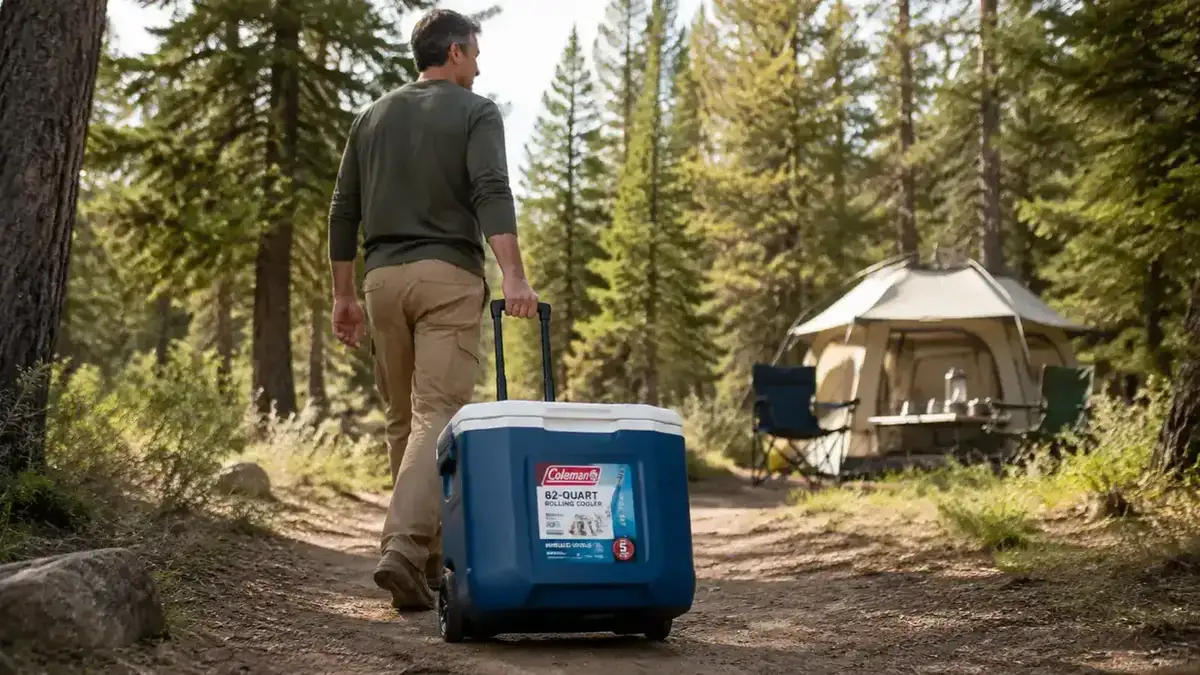
Coleman's five-day ice claim is technically achievable, but it requires conditions most campers will not hit on every trip. In my experience, packed with pre-frozen block ice, filled to about 75 percent capacity, and kept in shade, I have seen ice persist into day four and early day five. When I used cubed ice instead of block ice and skipped pre-chilling, I was draining water by midday on day three. The difference is not the cooler, it is the method. Block ice melts slower than cubed, full stop.
On the Smokies trip, daytime temps were in the low 90s for the first three days. We packed block ice from a gas station, pre-chilled the cooler overnight with a sacrificial bag of ice, and got 4.5 days before I called it and switched to eating shelf-stable foods. That is a real number under real heat. The cooler held 38 lbs of block ice initially and we added one top-off block on day three.
Block ice, shade, and a 30-minute pre-chill are worth more than any cooler upgrade. But this cooler does its job when you do yours.
One thing worth noting: the lid-to-body seal is a gasket-style foam seal, not a rubber lip gasket like on Yeti or RTIC. It seals reasonably well, but if you leave the cooler in hot sun for hours, the foam can warm and compress, which reduces the seal. I noticed this most on the road trip when the cooler sat in the car without shade for about four hours on day two. Ice life took a visible hit that afternoon.
Wheels and Handle: The Whole Reason to Buy This
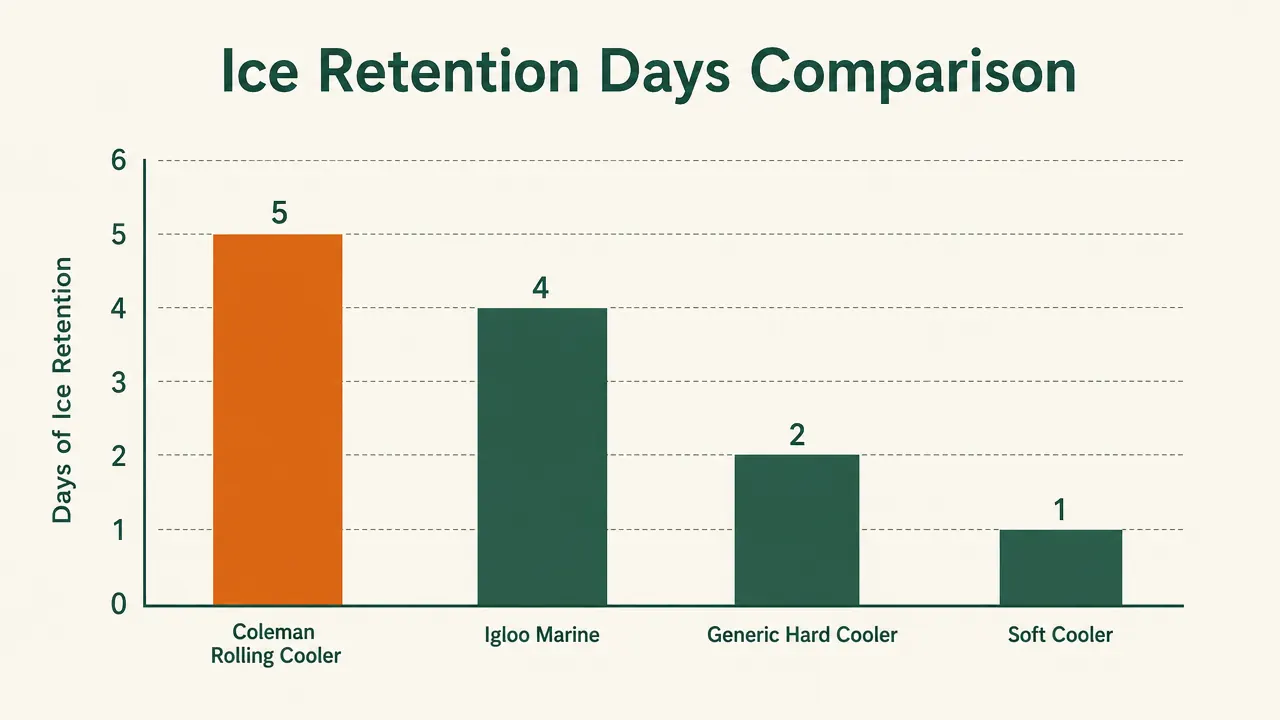
The wheels are 3.5 inches in diameter, hard plastic, and inline, one behind the other, not side by side. That inline layout tracks well on gravel but means the cooler wobbles slightly if you tilt it too far to one side while pulling. On pavement, it rolls effortlessly. On campsite gravel, it takes a little more force but still works solo. On loose sand, the wheels dig in after about four feet and you will end up carrying the front. Do not plan on rolling this on beach sand.
The telescoping handle extends to about 36 inches at full extension, which works for me at 5'11" but will feel short for anyone taller. It clicks into two positions: halfway (about 27 inches) and full. The button release on the handle is a simple thumb button that has never failed in three years. The handle does rattle slightly when the cooler is empty and rolling, which is a minor annoyance, not a durability issue.
After three summers, the wheel axles show no cracking and the hard plastic has no chips. I have rolled this over curbs. The wheel housing itself is part of the molded cooler body, not a bolted-on attachment, which is the right way to build it. Bolted-on wheel plates are the first thing to crack on cheaper rolling coolers.
Drain Plug: The Weak Spot Worth Knowing About
The drain plug is the part of this cooler that needs the most attention. It is a threaded plastic plug that screws into a molded drain hole on the back-lower corner of the body. The plug itself is fine, the thread engagement is solid and it has never leaked mid-trip. The problem is orientation.
The drain hole is positioned so that when you pull the plug to drain meltwater, the water runs out and over the wheel housing if you do not angle the cooler away from the wheels. On my third trip I drained it without tilting the cooler and got a cup of dirty meltwater sitting in the wheel axle recess. It dried out without rust or damage, but it is not where you want standing water. The fix is simple: tilt the cooler slightly away from the drain side when draining. Takes two seconds. Just know it is not obvious the first time.
The drain plug also does not attach to anything when removed, it is a loose piece. I put mine on a short loop of paracord attached to the cooler handle so it does not end up in the bottom of the meltwater. If you use this cooler, do the same thing the first day you own it.
Capacity and Packing: 62 Quarts in Practice
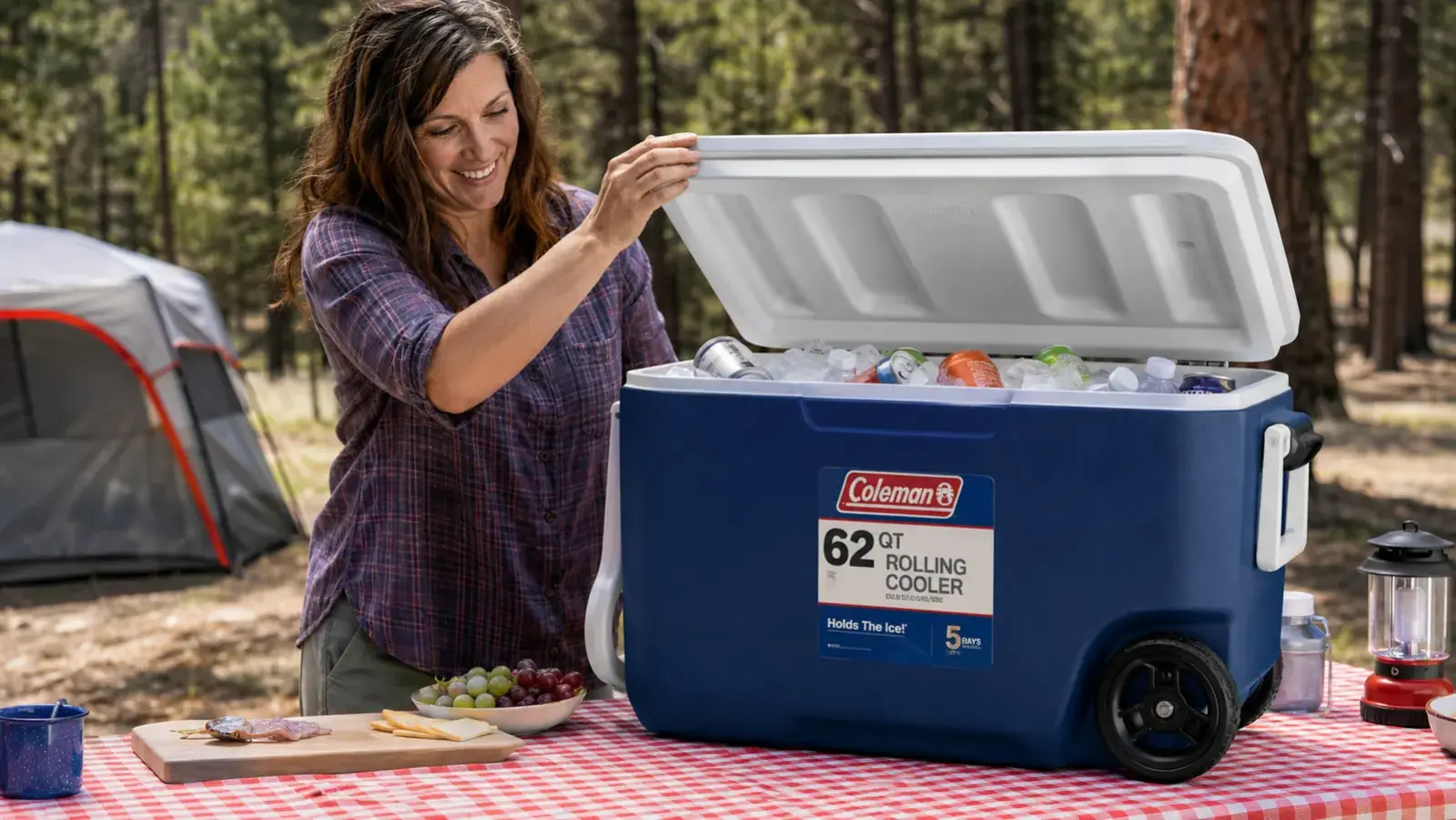
Sixty-two quarts is a lot of space if you use it well. The interior dimensions run roughly 23 inches long by 13.5 inches wide by 13 inches deep. That is enough to lay a full 10-inch cast iron skillet flat on the bottom if needed. For a family of four on a four-day trip, I typically run: block ice layer on the bottom (two 10-lb blocks), produce and dairy in the middle in zip-lock bags, and drinks and pre-made meal bags on top. With that layout I have two to three inches of headspace to spare.
The lid does not have any built-in storage, which is a miss for a cooler at this size. Some people tape a mesh pocket to the inside of the lid for condiment packets. It is a valid mod. The lid hinge is a two-point plastic hinge that has held up fine, but it does not stay open on its own, it flops fully open and then relies on the lid resting against the back. On sloped surfaces, the lid will slide closed on its own. Worth knowing at a campsite where everything is tilted three degrees.
The exterior has a built-in cup holder molded into the lid, which holds a standard 12-oz can or a 20-oz bottle. I use it about half the time. It is shallow enough that a full can will tip out in transit, so I only use it when the cooler is stationary.
Build Quality Over Three Years
The body is high-density polyethylene with foam insulation bonded inside. The outer finish has held up to UV exposure well, I have seen no fading or surface chalking, which is a common problem with cheaper coolers after two seasons in direct sun. The lid latch is a single bail-style metal wire latch, which I initially expected to be a weak point. It has not bent, corroded, or lost tension. I was wrong to worry about it.
The one cosmetic issue: the lid has developed two shallow scuff marks from being slid in and out of truck beds. These do not affect function. The handle button mechanism has a small amount of additional play compared to when it was new, it still clicks and locks, but you can feel a slight wiggle before it engages.
What I Liked
- Wheels and handle make solo transport genuinely practical across gravel and hardpacked surfaces
- Ice retention reaches four-plus days with block ice and proper packing in real camping conditions
- Wheel housing is molded into the body, not bolted on, no weak points there
- 62-quart interior fits a full four-day food load for four people with room to spare
- Lid latch has held up for three years without bending or corroding
- UV-resistant body shows no fading or chalking after three summers
Where It Falls Short
- Drain plug is loose and will get lost in meltwater without a tether modification
- Inline wheels sink in sand and struggle on soft ground
- Lid has no lid-stay, it flops open and will close itself on a sloped surface
- Foam lid gasket (not rubber lip) compresses in heat, reducing seal on long sun-exposed days
- Handle maxes out at 36 inches, which feels short for tall users
Who This Is For
This cooler is the right pick for car campers who do weekend to five-day trips and are tired of the two-person lift. If you drive to a campsite, park within 100 feet of your site, and cook real food for two to five people, the 62-quart Coleman rolling cooler handles your needs without requiring premium cooler discipline (the obsessive pre-chilling and bear-box-level latching that Yeti owners do). It is also a strong pick for anyone with a bad back or who camps alone and does not want to ask a stranger at the adjacent campsite for a hand every time they need ice. The 4.5-star average across over 8,000 reviews lines up with what I have experienced: reliable, practical, and honest about its limits.
Who Should Skip It
If you are going to beach camp on sand, look elsewhere, the wheels are useless there. If you need seven-plus days of ice retention for a long canoe trip or backcountry base camp where you cannot buy ice mid-trip, step up to a rotomolded cooler with a rubber gasket lid (Yeti Tundra 65, RTIC 65). Those run two to three times the price but will give you an extra 48 to 72 hours of retention in hard conditions. And if you are already happy with a chest cooler that you haul with two people and have a site helper every trip, the wheels are less of a selling point for you.
Three summers in, I would buy this again without hesitation.
The Coleman Classic 62-quart rolling cooler consistently delivers four-plus days of ice retention in real car camping conditions. Check today's price and stock on Amazon.
Amazon Check Today's Price on Amazon →