
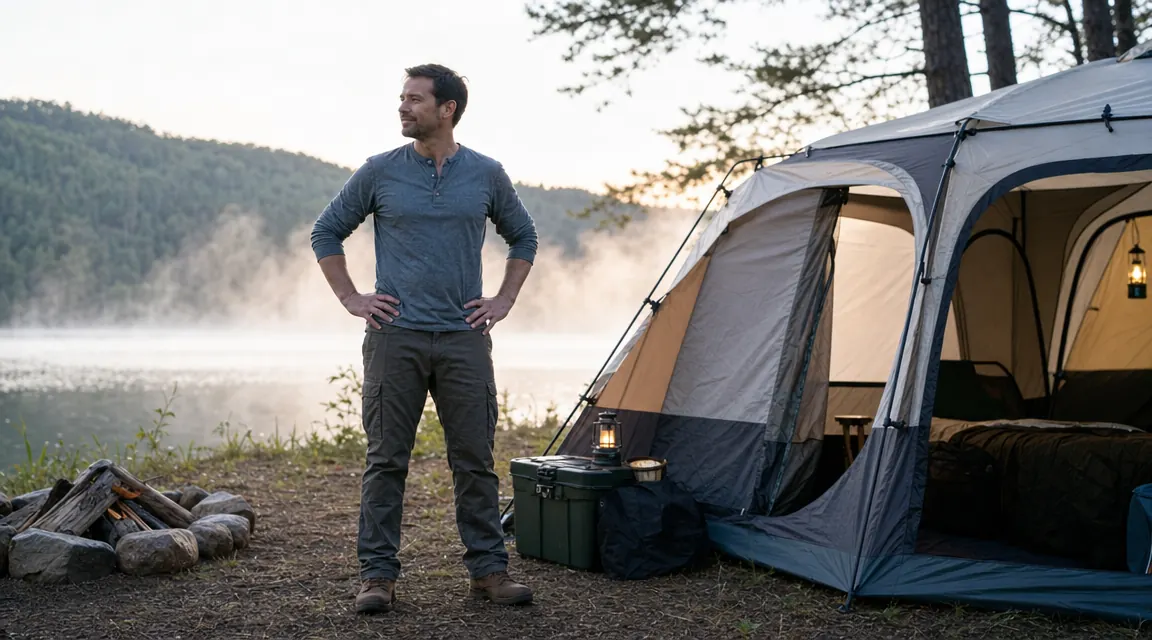
Here is the thing nobody writes in the product listing: the Coleman 6-Person Instant Tent goes up in about 90 seconds, and that part is genuinely great. What the box does not cover is everything that follows. The morning after your first hard rain when you reach up to check the ceiling seam above the door. The October trip when nighttime temps drop to 42 degrees and you wake up to wet sleeping bags from condensation, not a leak. The second season when one of the pre-attached pole hinges starts clicking on every open-and-close cycle. I have camped in this tent on 11 trips across two full seasons, including one night when a thunderstorm rolled through Big South Fork at 2 a.m. and I sat there with a headlamp counting drips. This review covers what that experience actually taught me, starting with the parts Coleman does not put on the hang tag.
The tent retails around $252 for the 6-person version (ASIN B0D6NQKDWJ). At that price it competes against the CORE 9-Person Cabin Tent and the NTK Arizona GT. It is not a backpacking tent and it is not trying to be. It is a car-camping shelter for families who want fast setup and a dry night. Whether it actually delivers on both of those goals, and under what conditions it fails, is exactly what this review covers.
The Quick Verdict
Fast setup holds up, but the waterproofing requires annual maintenance and the condensation management is the worst part of sleeping in it on cold nights.
Amazon Check Today's Price →If you already know you want it, here is today's price on Amazon
The Coleman 6-Person Instant Tent is in stock and ships quickly. If the honest tradeoffs below still work for your trips, the setup speed alone makes it worth considering.
Amazon Check Today's Price on Amazon →What the Waterproofing Rating Actually Means in Practice
Coleman rates the Instant Tent fly at 1,000mm hydrostatic head and the floor at 1,200mm. For context, 1,000mm means the fabric starts allowing water through under 1,000mm of standing water pressure. A light drizzle sits at roughly 100-200mm. A sustained heavy rain runs 500-800mm. A storm with driving wind and rain can hit 1,000mm and above on exposed panels. So the fly is at the ragged edge of what you want for a real weather night, not comfortably above it.
On the two trips where I had hard overnight rain, the body panels stayed dry. The problem came from the seam tape on the fly-to-pole junction points. Those seams are factory-taped, and after one full season the tape on the door seam had lifted about 4 inches on one corner. That corner dripped on my gear bag during a 2-hour moderate rain in May. Coleman says to re-seam annually. Most buyers do not know this and do not do it. A can of Seam Grip WP from any outdoor shop runs about $9 and takes 20 minutes once a year. If you skip it, season two is when you find out.
The floor tub is where the tent actually does well. At 1,200mm with welded corners (not taped), I have never had ground moisture come through the floor even on saturated ground. Coleman used thicker material on the floor than on the fly, and it shows. The weak point is not the floor, it is the seams on the upper rainfly, specifically around the front door and the rear vent panel.
The floor tub has never let in ground moisture, even on soaked ground. The seam tape on the fly door corner, that is a different story after one season.

The Condensation Problem Nobody Mentions
This is the part that frustrates buyers the most, and it has nothing to do with a defect. It is physics. The Instant Tent has a single-wall rainfly that sits close to the inner tent body. When six people sleep inside and outside temps drop below 50 degrees Fahrenheit, the warm moist air from your breathing hits the cold inner tent surface and condenses into water droplets. You wake up and the ceiling looks like it is sweating. Your sleeping bag feels damp on top even though it technically did not rain inside.
I had this happen on a 44-degree night at Mammoth Cave National Park in September. Four of us sleeping inside, door vents partially open. By 6 a.m. the inner ceiling had enough condensation that when I brushed it with my arm getting up, water dripped onto my pad. This is not a Coleman-specific failure, it happens in virtually every single-layer tent at these temps. But the Instant Tent is worse than average because the fly sits unusually close to the inner body across most of the roof, limiting airflow in the gap.
The fix that actually works: leave both the front door vents (the mesh panels) and the rear vent open simultaneously to create cross-ventilation. This drops the interior humidity by moving air through. On cold nights this means a slightly colder tent interior, typically 3-5 degrees cooler than with vents shut. That tradeoff is worth it. Keeping the vents closed to stay warm is how you end up sleeping in your own breath water.
Pole Hinge Durability: What Happens After 10-Plus Setups
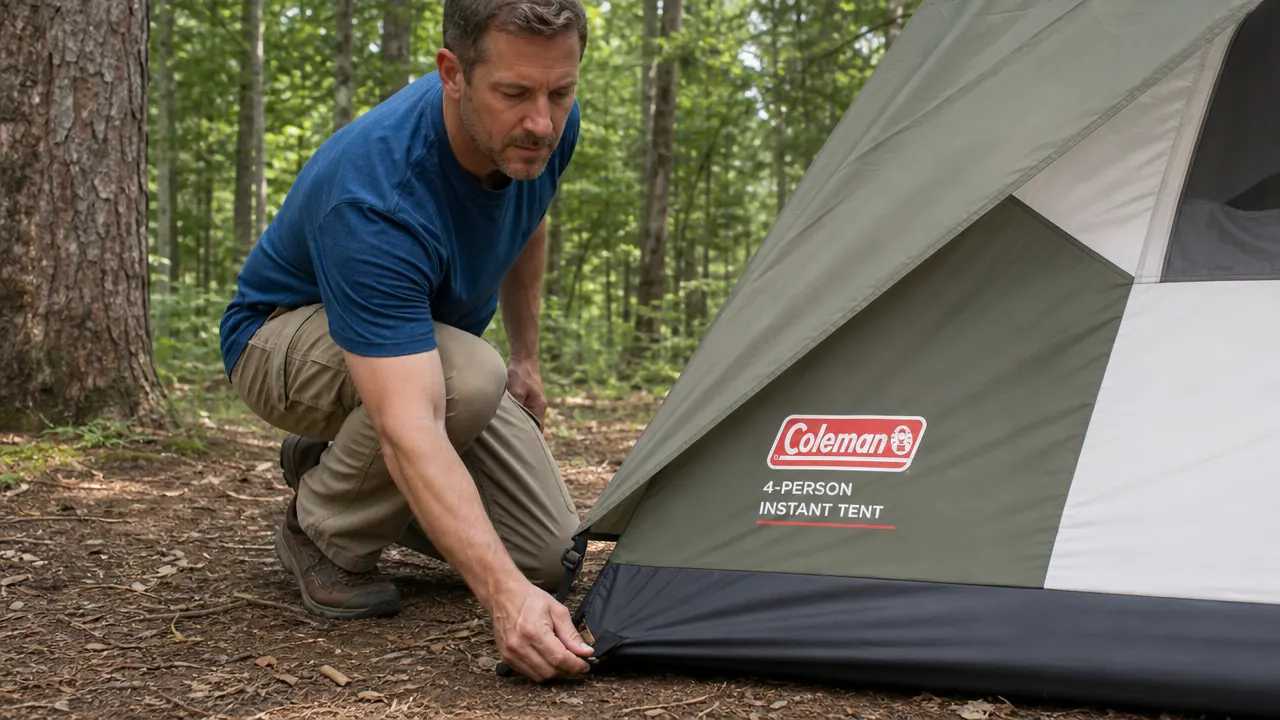
The pre-attached pole system is what makes the 1-minute setup possible. Each fiberglass pole section is connected to a central hub with a plastic hinge joint. You unfold the poles outward from the hub and they click into their locked position. Clean and fast.
After about 8 setups I noticed one hinge joint on the left rear pole started clicking rather than locking with a solid snap. By trip 11 it felt loose enough that I tapped it an extra time to confirm it was seated. It has not failed outright. But I have read enough one-star reviews (the tent has 23,866 ratings on Amazon as of this writing) to know that the hinge failure mode, when it does happen, is usually a cracked plastic hub where the pole connects. One broken hub makes the tent non-functional until you get a replacement part.
Coleman does sell replacement pole assemblies and the customer service line has been responsive in the cases I have read about. But this is a maintenance reality you should know about going in. If you camp 4-6 times per year and store the tent properly (more on that below), the poles should last 4-5 seasons without issue. If you set it up and take it down roughly or let a kid do the pole-folding unsupervised, plan for a hinge replacement sooner.
Folding It Back Down: The 1-Minute Setup Has a 10-Minute Teardown
This is the honest reality that every review skips because setup is so satisfying. Taking the tent down and getting it back into the carry bag is substantially harder than putting it up. The poles fold back in a specific sequence, and if you try to force them back before reversing the right sections first, they bind. The first time I broke camp solo it took me 18 minutes. By trip six I was consistently at 9-10 minutes. That is still four times longer than setup.
The main friction point is the carry bag. The tent folds into a cylindrical roll about 26 inches long and 11 inches in diameter. Getting the rolled tent to fit back into the bag requires a specific rolling direction, tight from the foot end, with the hub in the center of the roll. Coleman does not document this clearly. There is a YouTube video from a Coleman rep showing the exact technique that knocked 4 minutes off my teardown time once I watched it. Before you leave home on your first trip, watch that video once.
If you are camping with kids and need to break camp fast, assign one adult to nothing but tent teardown. This is not a job to hand off while you are also packing coolers and deflating sleeping pads.
Floor Thickness, Ground Conditions, and What You Actually Need Under It
The factory floor is approximately 68D polyester. That is thin enough that sharp gravel will eventually abrade it. On two of my 11 trips I camped on sites with chunky gravel and I could feel the larger pieces through the sleeping pad. No punctures in two seasons, but I could see the fabric showing wear marks at the gravel contact points.
A ground cloth (footprint) under the tent is not optional on anything harder than soft grass or dirt. Coleman sells a branded footprint, but any 8x10 poly tarp cut to size works. Keep the footprint slightly smaller than the tent floor so rain does not channel between the footprint and the floor. I use a $14 cut-down tarp that has outlasted two tents already. The abrasion from the rocky ground hits the tarp, not the tent floor.
What I Liked
- 1-minute setup is genuinely achievable after two practice runs at home
- Floor tub with welded corners handles ground moisture reliably
- 56 sq ft of interior floor space fits two queen air mattresses side by side with room to walk
- Room divider curtain gives real privacy partition, not just a symbolic one
- E-port cable pass-through is routed usefully near the floor, not the ceiling
- Carry bag has a shoulder strap that actually holds under the full weight of the tent
Where It Falls Short
- Seam tape on fly needs annual retreatment or season-two leaks are likely
- Condensation on cold nights (below 52 degrees F) is significant without cross-ventilation
- Pole hinge plastic shows wear after 8-10 setups; cracked hub is the documented failure mode
- Teardown takes 9-12 minutes solo; dramatically longer if you do not know the rolling sequence
- 68D floor needs a ground cloth on anything harder than soft grass
- At 17.9 lbs the bag is heavy to carry from a parking lot more than 200 feet
The Dark Room Feature: What It Does and Where It Falls Short
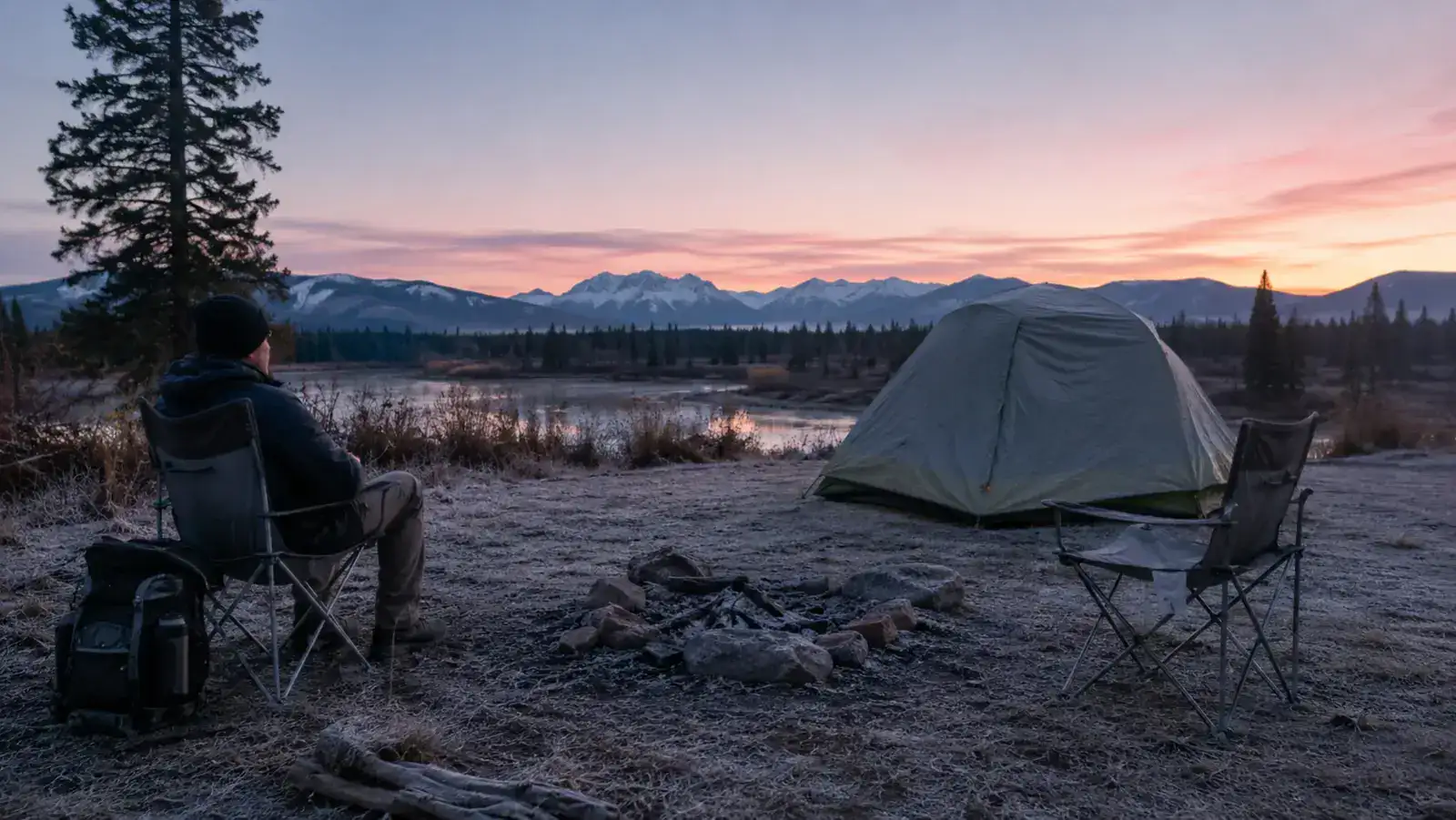
Coleman sells a Dark Room variant of this tent alongside the standard version. The Dark Room coating blocks about 90% of incoming sunlight, which makes a real difference for sleeping past 6 a.m. at summer campsites facing east. I tested a neighbor's Dark Room version on one trip at a Tennessee state park. The interior was noticeably dimmer at 7 a.m. compared to my standard-fly tent, maybe equivalent to mid-afternoon shade rather than bright morning light.
The tradeoff is that the Dark Room coating traps heat more aggressively. On a 75-degree morning with the sun up, the Dark Room interior was about 8 degrees warmer inside than my standard tent. For summer camping in the Southeast or Southwest, that is something to factor in. The coating is also the one element that does not respond well to cleaning with anything stronger than a damp cloth. Scrubbing the fly with a brush degrades the coating. If your camping site has tree sap or bird droppings on the fly regularly, the Dark Room version takes more care to maintain.
Who This Tent Is Right For
The Coleman Instant Tent makes the most sense for car campers who prioritize setup speed above everything else, camp at developed sites with relatively flat tent pads, and do not need expedition-grade wet-weather performance. Families with young kids who are trying to get camp set up before meltdowns happen will get real value from the 90-second pole system. Weekend campers who do two to four trips a year and store gear properly will see multiple seasons of reliable use without hitting the pole-hinge failure mode.
If you camp a lot, six or more trips per year, and want a tent that handles heavy rain without annual maintenance, I would look at the REI Base Camp 6 or the Marmot Limestone. Those run $100-150 more at current prices and require a pole-threading setup, but their seam construction and waterproof ratings are a tier above what Coleman offers here.
Who Should Skip It
Skip this tent if you camp in the Pacific Northwest or anywhere that gets persistent multi-day rainfall. The 1,000mm fly rating and seam-tape construction are not built for that environment. Skip it if your camping sites are rocky and you do not want to deal with a ground cloth. Skip it if you are a solo camper or a couple, the tent is optimized for six people and at that size it is genuinely large; a two-person doesn't need 56 square feet of floor and 17.9 lbs of carry weight.
Also skip it if teardown time matters to you as much as setup time. The asymmetry there is real and it is not going to change with practice beyond a certain point. Some people accept a 10-minute teardown happily. Others find it frustrating every single time. Only you know which camp you fall into.
The fastest-pitching 6-person tent at this price point, if the tradeoffs work for you
The Coleman Instant Tent has 23,866 ratings and ships prime. Annual seam maintenance and a ground cloth are the two additions that turn a good tent into a reliable one. Check current availability below.
Amazon Check Today's Price on Amazon →