

If you are shopping for a two-burner camp stove in the $90 to $140 range, the Camp Chef Explorer and the Coleman Triton will both land near the top of every search result. They are the two stoves I see most often at campgrounds, and I have cooked on both long enough to have a clear opinion. The short answer: if you cook real food outside, the Camp Chef Explorer wins. If you are mostly heating soup and boiling water for coffee on weekend car camping trips, and weight or price matters more than output, the Coleman Triton is a reasonable choice. This article lays out why, spec by spec.
I will be direct about where each stove falls short, because both have genuine tradeoffs. The Explorer is heavier, costs more, and takes up more truck space. The Triton runs light, packs flatter, and costs less up front. But once you try to sear a steak or run a cast iron at high heat on the Triton's 10,000 BTU burners, the gap between these two stoves becomes very obvious very fast.
| Camp Chef Explorer EX60LW | Coleman Triton 2-Burner SPS | |
|---|---|---|
| Total BTU Output | 60,000 BTU (2x 30,000 BTU burners) | 20,000 BTU (2x 10,000 BTU burners) |
| Packed Weight | 12.4 lbs | 9.5 lbs |
| Cook Surface (per burner grate) | 14 in x 16 in, thick cast-iron-bar grate | 12 in x 12.5 in, standard wire grate |
| Leg System | Modular: 3 height settings (22 in / 30 in / 38 in) | Fixed legs, approx. 7 in working height |
| Ignition | Matchless push-button ignition per burner | Matchless push-button ignition per burner |
| Accessory / Modular System | Yes: griddle plate, BBQ box, Dutch oven tri-pod, wok ring sold separately | None: stove only, no Camp Chef-style accessory system |
| Windscreen Design | 3-sided wrap panels, burner heads well shielded | 2 fold-out side panels, front of burner exposed |
| Price Tier | Mid-high (current price around $128) | Mid (current price around $65-75) |
| Warranty | 3 years (Camp Chef direct) | 1 year (Coleman) |
Triple the BTU, adjustable height, a real accessory system, see today's price on the Camp Chef Explorer
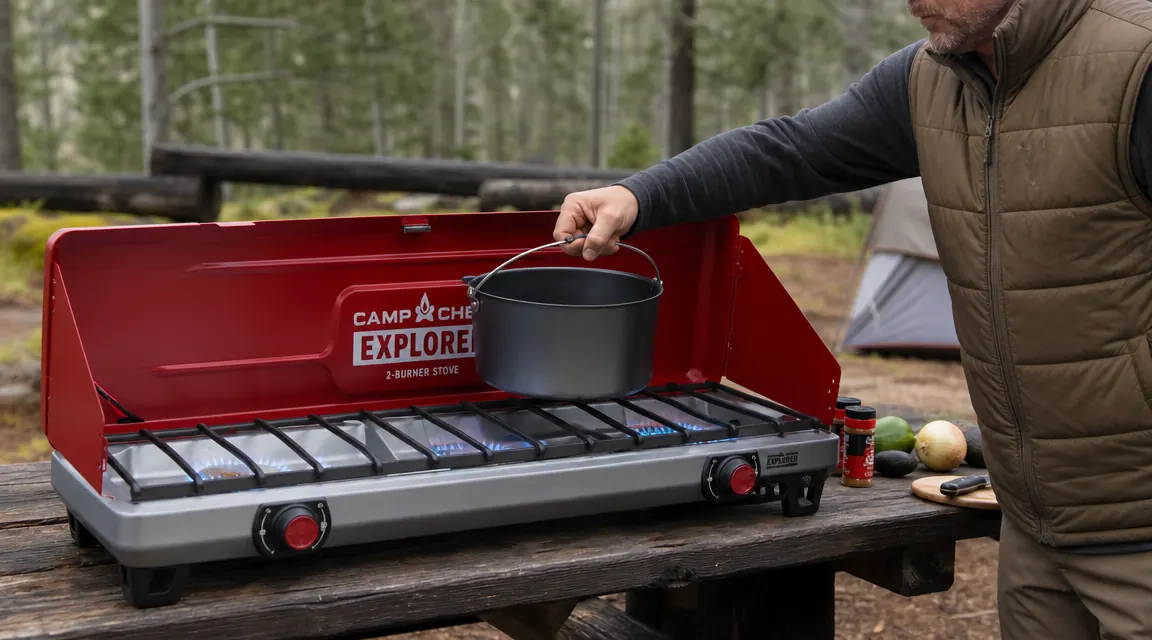
The Explorer puts out 30,000 BTU per burner, accepts a griddle plate, and stands at countertop height on the tall legs. It is the stove I'd put in anyone's truck if they cook more than two people's worth of food outside.
Amazon Check Today's Price on Amazon →Where the Camp Chef Explorer Wins
The BTU gap is the real story. The Explorer runs 30,000 BTU per burner, and both burners operate independently at that output. That is enough heat to boil a gallon of water in roughly four to five minutes, get a 12-inch cast iron to a true searing temperature, or keep a large stockpot at a full rolling boil while the second burner handles something else at the same time. The Triton's 10,000 BTU burners will eventually boil the same water, but you are waiting 10 to 12 minutes for that pot, and if there is any wind at all, output drops noticeably.
The Explorer's windscreen panels are three-sided and wrap close to the burner heads. That design makes a real difference on exposed campsites. I have cooked on it at 7,500 feet elevation in a ridge-top campground in Wyoming with a steady 15 mph crosswind blowing off the mountains and the flame held steady at every setting. The Triton's side panels fold up but leave the front of the burner fully exposed. At any real wind speed, you will be chasing your flame adjustment every few minutes. That is not a guess; that is two mornings of trying to cook eggs in the same conditions with both stoves.
The modular leg system sounds like a marketing bullet point until you actually use it. At the 38-inch tall setting, the Explorer sits at counter height, which means you stand upright to cook rather than stooping over a picnic table. For a three-day camp trip where you are cooking six meals on a 12-inch cast iron, that posture difference is real. The Triton sits about 7 inches off whatever surface you place it on. If that surface is a standard picnic table, you are leaning forward all morning. The Explorer's legs also lock into each height setting securely; I have never had one slip or bounce during a hard boil.
At the tall leg setting the Explorer sits at counter height. For a three-day trip where you cook six meals, that posture difference matters more than the weight difference.
Where the Coleman Triton Wins
Weight and pack size are the Triton's honest advantages. At 9.5 lbs folded versus 12.4 lbs for the Explorer, the Triton is meaningfully lighter for anyone loading a fully packed car and counting every cubic foot. The Triton folds into a flat clamshell profile that slides between bags easily and does not add height to a gear stack. The Explorer, with its leg system and larger grate area, is bulkier in all three dimensions. It does not compress as thin and it will not slide between a bag and the wheel well the way a clamshell stove can.
Price is the other genuine edge for the Triton. It typically runs $50 to $60 lower than the Explorer. If you are putting together a first camp kitchen on a tight budget, or your cooking on the road is genuinely just two people making oatmeal and reheating canned chili, the Triton covers those needs without the extra spend. Its matchless ignition is reliable, both burners light cleanly on the first or second push, and the wire grate holds a standard aluminum camp pot or pan without issue.
The Triton is also more forgiving to someone who has never cooked outdoors on a propane stove before. The lower BTU output means a beginner is less likely to scorch food by leaving the valve open at max on a thin pan. For a family taking their first few camping trips and figuring out outdoor cooking as they go, the Triton is a reasonable entry-level stove. The problem is that entry-level cooking needs tend to expand quickly once people realize how much better camp food can be.

Cast Iron Compatibility and Real Cooking Load
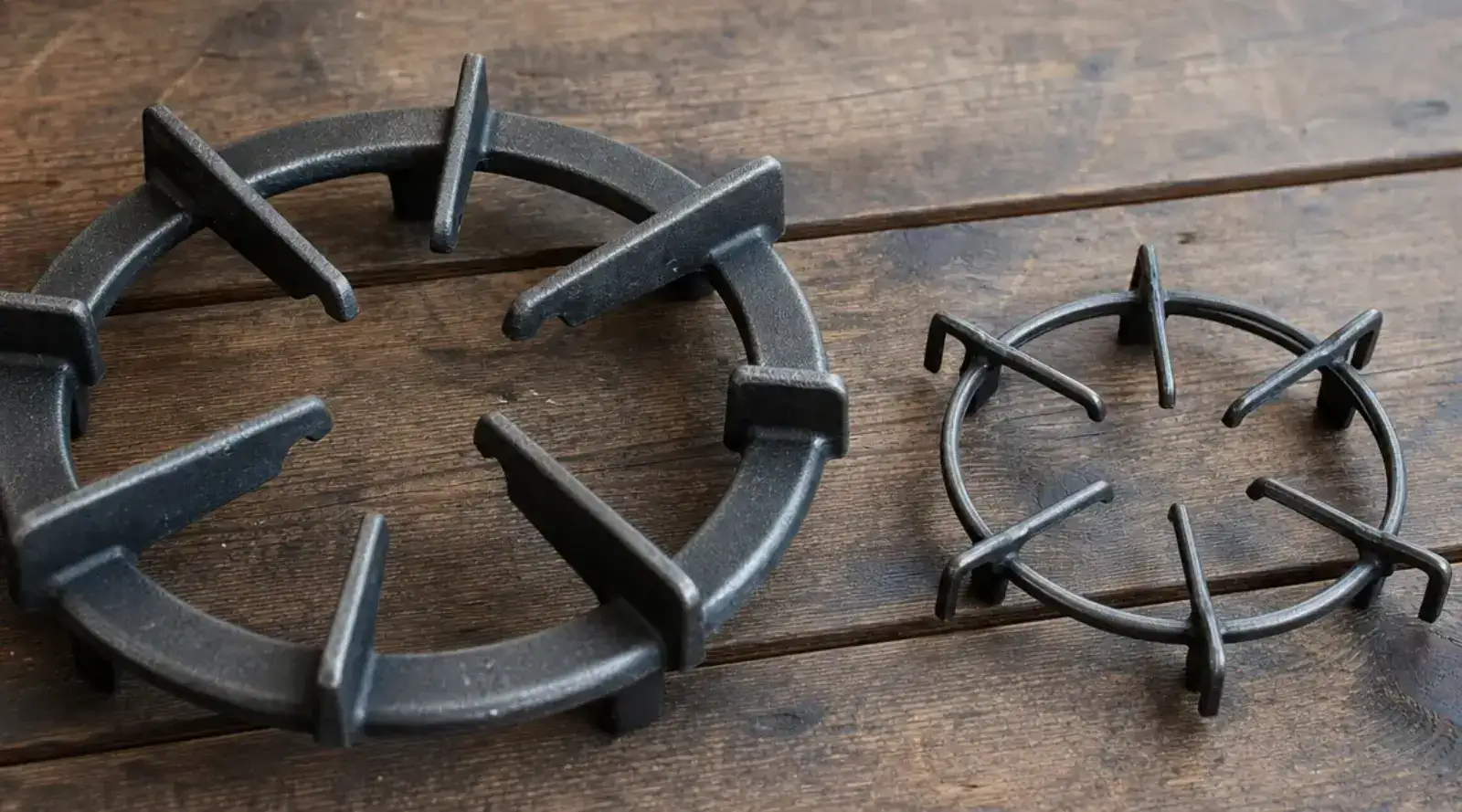
This is where the Explorer separates itself most clearly from the Triton. The Explorer's burner grates are thick cast iron bars, spaced wide enough to support a 10-inch or 12-inch cast iron skillet without wobble. The heavy grate also acts as a heat buffer, helping distribute the high BTU output more evenly across the pan bottom. I have run a 12-inch Lodge carbon steel skillet at full heat on the Explorer with no stability problems and consistent heat distribution from edge to center.
The Triton's wire grate can technically hold a cast iron skillet, but the grate flexes slightly under the weight, and at the Triton's 10,000 BTU maximum output you still cannot reach true searing temperature in a cast iron. For a thin aluminum camp pan heating canned soup, the Triton handles it fine. For any real camp cooking, including breakfast for four people, cast iron cornbread in a Dutch oven, or stir fry in a heavy wok, the Explorer is the correct tool and the Triton is not.
The modular accessory system adds another layer that the Triton simply does not have. Camp Chef sells a flat griddle plate, a BBQ box with raised grill grates, a wok ring, and a baking chamber that all sit directly on the Explorer's burner heads without adapters. I own the flat griddle and use it on roughly 40 percent of our camp trips. Pancakes for four people on a two-burner griddle plate at 6 a.m. before a hike is genuinely easy with the Explorer setup. There is no equivalent accessory path with the Triton.
Ignition, Knobs, and Propane Use
Both stoves use matchless push-button ignition and both have been reliable in my experience. The Explorer's piezo igniter is positioned close to each burner head and lights on the first or second push at least 19 times out of 20 in warm conditions. In cold weather, below 40 degrees F, I carry a standard lighter as backup on both stoves because propane vapor pressure drops and piezo systems slow down. That is not a knock on either stove; it is just how propane behaves in cold ambient temperatures.
The Explorer's valve knobs are larger and have a more positive feel through the simmer range. You can genuinely simmer on 30,000 BTU burners because the low end of the valve travel is well controlled across a longer arc. I have simmered a pot of chili for 45 minutes on the Explorer without the flame dying or surging. The Triton's knobs are smaller and the medium-to-low transition feels less precise, though for most camp cooking that level of control does not matter much.
On propane consumption: the Explorer burns through fuel faster at full output because the BTU output is three times higher. On a standard 1 lb canister, the Explorer at full blast on one burner will exhaust it in about 45 minutes. Running both burners at full, plan on a 1 lb canister lasting 20 minutes. Most cooking does not happen at full blast, so real-world trip use on a standard 16.4 oz disposable canister is more like 2 to 3 hours of mixed cooking. The Explorer is designed to also accept a 20 lb bulk propane tank via a standard hose adapter, which solves the fuel consumption question on longer trips.

Who Should Buy Which
Buy the Camp Chef Explorer EX60LW if: you cook for more than two people at camp, you use cast iron cookware, your trips run longer than two nights, you want a modular platform you can add accessories to over time, or you camp regularly in exposed or windy conditions. The Explorer handles serious outdoor cooking and will outlast a cheaper stove by several seasons. At 4.7 stars across 9,450 Amazon reviews, it earns that rating honestly. The 3-year warranty is also a real differentiator when you are choosing between gear you will use for years and gear you might be replacing in two seasons.
Buy the Coleman Triton if: your camp cooking is genuinely minimal (coffee, oatmeal, canned meals), vehicle space is tight and every pound counts, the lower price is the deciding factor, or you are introducing a family to camping and want an inexpensive first setup before upgrading. The Triton is a functional stove. It is just not the right stove for anyone who plans to cook real food outside on a regular basis.
If you are on the fence, think back to the last three camp meals you cooked or planned to cook. If any of them involved a cast iron pan, a pot larger than 2 quarts, or feeding three or more people at the same time, the Explorer is the correct answer. The price difference buys you triple the BTU output, better wind protection, adjustable height, a 3-year warranty, and a modular accessory platform you will actually use more trips than not.
The Explorer handles anything a camp kitchen throws at it, check today's price before it moves
Camp Chef Explorer EX60LW: 60,000 BTU total output, modular adjustable legs in three heights, cast iron-ready thick grates, 3-year warranty. The stove that earns its weight in the truck on every trip.
Amazon Check Today's Price on Amazon →